A ready-to-assemble gun safe ships flat or in a few parts and goes together with a screwdriver. A pre-assembled safe arrives as a finished box. The choice looks like a convenience question, but it touches the threats you care about: makers argue that how the walls are joined affects how a thief might attack them, the finished weight affects how easy the safe is to carry away, and the box you can fit through your door decides whether you can get it home at all.
This guide compares the two approaches using the listings compared below, separating what the makers state from what is simply sensible. The ready-to-assemble examples are all Kaer models, so this is not a survey of the whole market. A safe does not replace supervision, and none of these listings states a theft rating, whether the cabinet came in a box or fully built.
- Welded one-piece bodies are the maker’s design choice, not a tested rating.
- Flat-pack is easier to carry; assembled is easier to set up. Weight and anchoring matter for both.
- Light safes of either type should be anchored. [1]
- Test the finished lock and latch before loading any safe.
What assembled and flat-pack actually mean
A fully assembled safe is built at the factory and may have welded seams. A ready-to-assemble safe is shipped in parts and joined at your house. One Kaer no-assembly listing states the difference directly: unlike flat-pack gun safes, it arrives fully assembled, and its one-piece welded steel body has no visible exterior seams, which the maker says adds strength and helps resist prying or forced panel separation.
That is the maker’s claim, not a laboratory result. The listing names no burglary rating. What it does tell you is the design intent: no visible exterior seams for a prying attack to work on. It is a reasonable thing to prefer, but it should not be mistaken for tested resistance.
Pre-assembled models compared
Kaer 2-3 Rifle Cabinet 1320W (pre-assembled)
This small cabinet lists that it comes already assembled with pre-drilled holes for the floor or wall, a package-list weight of 46.97 lbs (its product table says 47.07 lbs). At that weight someone could carry it off unless it is bolted down, so assembled does not mean immovable.
Kaer 3-5 No Assembly Required gun safe
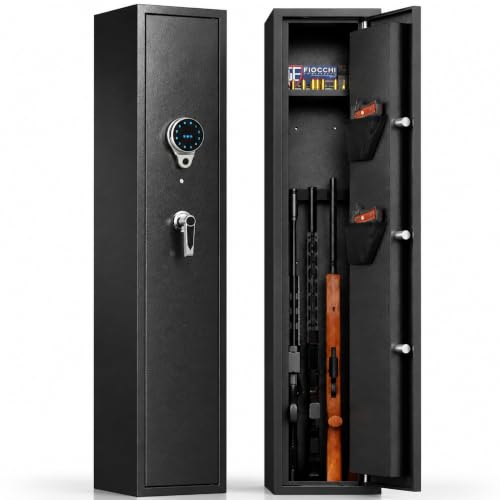
The no-assembly 3-5 model lists a one-piece welded steel body, a reinforced door with 60mm overall thickness and three 20mm solid steel locking bolts, plus a keypad and external power box. Those are the maker’s specifications.
VALINIRT 14 Gun Fireproof Safe
The VALINIRT 14 gun model lists a fully assembled build that weighs 200 lb, pre-drilled holes for floor mounting and a 45-minute fire claim at 1400°F. A larger assembled safe like this changes the delivery question: it likely needs a clear path and more than one person.
KAUYU Large Fireproof Gun Safe
This listing says it arrives fully assembled, with pre-drilled mounting holes and an integrated welded structure that the maker says enhances stability.
Ready-to-assemble models compared
Kaer 10-12 Gun Safe Fingerprint 1380CZ
The listing says it requires assembly, includes the necessary hardware and an installation video, and that installation requires 1-2 people. It lists a weight of 64.15 pounds. Pre-drilled holes on the back and bottom allow wall or floor mounting.
Kaer 8 Rifle Gun Safe 1400CZ
The 1400CZ is described as requiring assembly, with gloves, a screwdriver, four expansion bolts and an instruction manual in the box. It lists a weight of 76.05 lbs.
Kaer 15-20 DIY Large Gun Safe 1500A+1500B
The DIY pair ships in two packages. The 1500A weighs 78.70 lbs, the 1500B weighs 60.19 lbs, and the two together weigh 139.8 lbs. The modular design is a real benefit if you need to carry parts up a staircase, but it means the finished unit is made of joined sections, not a single welded body.
How the choice affects the threats you care about
Burglary: a heavy, welded safe is harder to move and may be harder to pry, but the listings say this in the makers’ words, not a rating. Weight is the easiest of these factors to compare. A loaded safe can weigh well over a thousand pounds, according to Liberty, and Liberty says to anchor it, noting the damage a 1,000-pound safe can do if it tips over. [2] [3]
Tip-over: a burglar who can tip a safe onto its back finds prying the door off typically much easier. [3] This applies whether the safe was assembled in a factory or in your living room. Use all the mounting holes, whichever type you buy.
Children: neither approach makes a lock child-proof. The American Academy of Pediatrics advises that all guns in the home be locked and unloaded, with ammunition locked separately. [4] Assembly errors can also matter: a door that does not latch, or a bolt that does not engage, can defeat the lock, so test the finished safe before loading it.
Delivery, doorways and stairs
Flat-pack has the logistics advantage in these listings: the ready-to-assemble Kaer models state weights of 64.15 lbs, 76.05 lbs and, for the two-piece set, 78.70 lbs and 60.19 lbs per piece [2].
An assembled safe at 200 lb, like the VALINIRT, is the kind of load to plan a rated hand truck for. Liberty says one of its safes needs a hand truck or dolly that can hold at least 800 pounds, and warns that some floors and stairs aren’t built to handle a big safe’s weight. [2]
Measure the doorway, hallway and stairwell, and check the safe’s depth with its handle.
Then decide: if the route is tight, a flat-pack model or a modular pair may be the only way in. Keep the packaging and the parts bag until you have confirmed that the lock, alarm and door all work, because a return is easier before the panels are joined. Lay out the parts first, read the manual end to end, and ask a second person to help while you assemble, since a cabinet that is slightly out of square may bind the door.
Mounting and rating notes
The burglary standard UL revised includes a drop test for products weighing 750 pounds or less, but a product that can be reliably and safely mounted to a surface, with the manufacturer providing installation provisions and instructions, does not have to be subjected to the drop test. [1] In plain terms, the standard treats mounting provisions and instructions as an alternative to drop testing for lighter safes, which is one more reason to anchor a light safe of either type.
Before you bolt anything down, assemble the safe fully, check that the door swings and the bolts throw, and confirm the keypad works with a spare key in your hand. Keep the key out of the safe, as SentrySafe’s manual warns. [5]
Which to choose
- Choose pre-assembled if you can get it through the door and want a welded body, accepting that welding is a design claim, not a rating.
- Choose ready-to-assemble if access is tight or you want modular capacity. In these listings price does not track assembly type: the two least expensive models are pre-assembled.
- In either case, bolt it down, check the lock, and read the rating guide before trusting fire or burglary claims.
FAQ
Is a pre-assembled gun safe more secure?
Not automatically. A welded body may have fewer visible seams, which Kaer says helps resist prying, but that is a design claim and not a rating.
How long does it take to assemble a gun safe?
The listings do not give a time. One says installation requires 1-2 people and includes hardware and an installation video.
Do I need to bolt down a ready-to-assemble safe?
Yes, and so does an assembled one. Liberty says you should always anchor your safe to the floor. [3]
Can an assembled safe fit through my door?
Check the dimensions and the route before ordering. Heavy assembled safes will likely need a hand truck rated for the load, and Liberty warns that some floors and stairs aren’t built to handle the weight. [2]
A safe that is not put together correctly may not protect what is inside. Bolt it down, test the lock and latch, and keep codes and keys from children; a safe does not replace supervision.
Sources
- Residential Security Container Standard Revised. UL Solutions, accessed 2026-10-13
- Tips for Moving a Gun Safe on Your Own. Liberty Safe, accessed 2026-10-13
- Anchoring Your Gun Safe to the Floor. Liberty Safe, accessed 2026-10-13
- Handguns in the Home (HealthyChildren.org). American Academy of Pediatrics (HealthyChildren.org), accessed 2026-10-13
- Security Safe Owner's Manual (X-Model). SentrySafe (Master Lock), accessed 2026-10-13
Fire, burglary and lock ratings are quoted as the manufacturer or testing lab states them, with the source on each page. Safe-storage and child-access laws vary by state and change; check your state's current statute. No safe or lock replaces supervision of children around firearms. We do not sell or link to firearms or ammunition. This is general information, not legal advice. As an Amazon Associate we earn from qualifying purchases.
