Bolting a safe down answers two threats at once. The first is a burglar who tips the safe onto its back, where prying the door off is typically much easier, or who simply carries a lighter safe away. [1] The second is the safe itself: it is worth considering the damage a 1,000-pound safe can do if it tips over. [1]
This guide covers what safe makers publish about anchoring, which holes and hardware come with common safes, how floor and wall mounting differ, and the mistakes that leave a bolted safe still movable. The sourced steps come from maker manuals, so your own safe’s manual overrides anything here.
- Liberty says anchoring matters because tipping a safe onto its back makes prying the door easier. [1]
- Liberty’s guide gives a 3/8 bit for concrete and a separate quarter-inch hole step that does not name a floor type; tile cannot be anchored. [1]
- Pick floor or wall as the safe’s manual directs; SentrySafe’s manual advises against both. [2]
- A loaded safe can weigh over a thousand pounds, so plan the route before delivery day. [3]
Why anchoring matters more than most buyers expect
A burglar who cannot defeat a lock still has options if the safe can move. Liberty Safe’s anchoring guide says plainly that you should always anchor your safe to the floor. [1] SentrySafe’s owner’s manual says that to help provide maximum security, bolt down is strongly recommended. [2]
Anchoring also shows up in the burglary standard. The burglary standard UL revised includes a drop test for products weighing 750 pounds or less, but a product that can be reliably and safely mounted to a surface, with the manufacturer providing provisions and installation instructions, does not have to be subjected to that drop test. [4] In plain terms, a lighter safe is either drop tested or designed to be mounted with instructions, so a light safe left loose is not being used the way the standard assumes.
What the maker guides say to do
These steps come from two manufacturer guides and describe what those makers publish for owners. They are not a substitute for the manual that came with your safe.
Concrete floors
Liberty Safe’s guide calls for a hole at each of four anchoring locations, drilled in a concrete floor with a 3/8 concrete drill bit. [1] Use every location the guide names; skipping one departs from the published method.
The quarter-inch hole step
The same guide also describes drilling a 1/4-inch hole in each of the four anchoring locations. [1] The published step does not say which floor type it is for, and the guides cited here give no fastener sizes or joist spacing for wood, so do not guess. Follow the safe’s own manual and check what is under the floor before you drill.
Tile floors
Unfortunately, the guide says, you can’t anchor a safe to a tile floor. [1] If your planned location is tiled, plan on a different room or a different surface.
Floor or wall: pick one
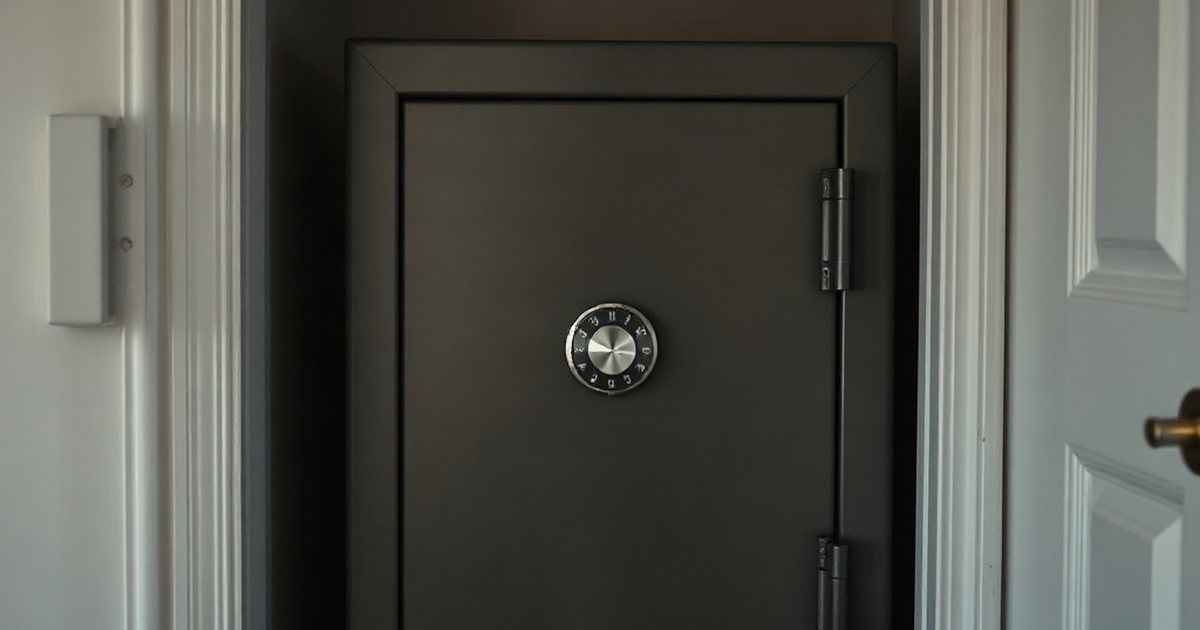
Some cabinets, such as the first Kaer cabinet below, ship with pre-drilled holes on both the back and the bottom, which makes them look like they could be fixed to the wall and the floor.
SentrySafe’s manual says that it is not recommended to attempt to bolt to both floor and wall. [2] That advice is aimed at its security safes; for any other model, read the maker’s instruction before using both.
Whichever you choose, use every mounting point the maker provides.
What comes in the box: examples from listings
Listings differ a lot in what hardware they supply. These examples show what is stated, not what is installed on your wall.
Steelwater 16 Long Gun (EG592216-AM)
The Steelwater 16 long gun safe lists reinforced bolt-down holes in each corner, a weight of 330 lbs, and exterior dimensions of 59 by 22 by 16 inches. Its listing is for curbside delivery only, so plan how it gets from the curb to its final spot before buying. A 330-pound safe still tips, so using all four corners matters.
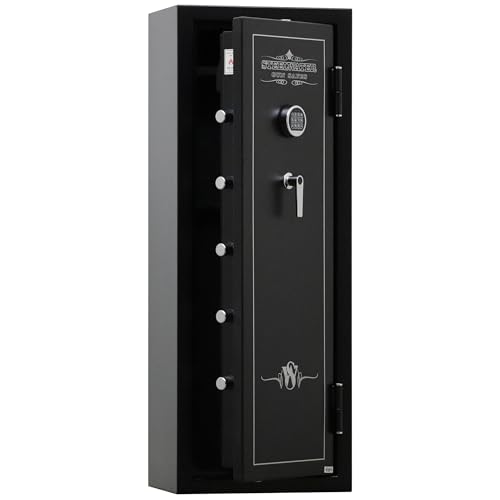
Kaer 10-12 Gun Safe Fingerprint 1380CZ
The Kaer 1380CZ listing says its pre-drilled holes on the back and bottom allow wall or floor installation, installation requires 1-2 people, and it includes expansion bolts and a screwdriver. It lists a weight of 64.15 pounds. At that weight, one or two people could carry the cabinet out if it is left unbolted.
Kaer 10-14 Fingerprint Large Gun Safe 1500CZ
The Kaer 1500CZ lists a floor mount type, pre-drilled anchor holes on the base and back, four expansion bolts in the box and a weight of 78.7 pounds. Those expansion bolts are what the listing supplies; confirm they suit the surface you actually have.
VALINIRT 14 Gun Fireproof Safe
The VALINIRT 14 gun model lists a weight of 200 lb with pre-drilled holes for floor mounting. At 200 lb it is heavier than a small cabinet, but a few people could likely still move it if it is unbolted.
Choose the spot before you drill
Once the holes are in the floor, the position is permanent, so settle it first. Check door swing: one SentrySafe 1.2 cubic foot model lists that its door requires 14.75 in. of clearance to fully open, and a safe tucked into a tight closet can end up with a door that cannot swing wide enough to use the interior.
Check what is nearby too, because a safe in a corner that blocks the door of the room is a safe you will be tempted to move.
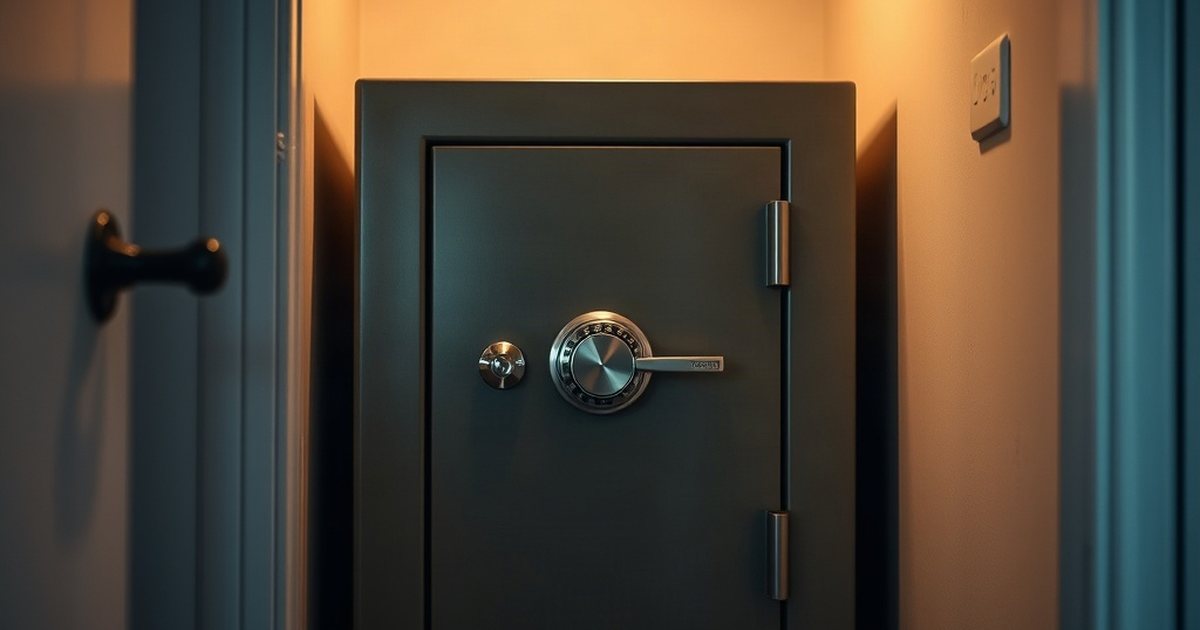
Also think about what you want from the location. Where the safe sits affects how quickly you can reach it, how visible it is to visitors, and what surface you can anchor it to. There is no single right room; weigh access, visibility and the floor under it, and keep the safe out of reach of children.
Moving the safe before you bolt it
A loaded gun safe can weigh well over a thousand pounds, and in many cases 2 or 3 thousand pounds, with some models weighing up to 3,100 pounds. [3] Liberty’s first recommendation for moving a big safe on your own is not to, and it notes that some floors and stairs are not built to handle that weight. [3] For one of its models, the guide says you will need a hand truck or dolly that can hold at least 800 pounds, so check the weight of your own safe first. [3]
Smaller cabinets are manageable, but two people is a sensible minimum for a tall cabinet. A cabinet that tips while being positioned is the same hazard bolting is meant to remove.
Mistakes that leave a bolted safe still vulnerable
Leaving the key in the safe is a classic problem. SentrySafe’s manual says plainly not to place the override key in your safe, and if you are locked out it asks for proof of ownership through the maker. [2] Keep spare keys away from children and teens too, since the American Academy of Pediatrics advises making sure children and teens can’t access keys or combinations to lock boxes or gun safes. [5]
Bolting also does not turn a thin cabinet into a rated safe. A lightweight cabinet with a fixed base is harder to carry off, but none of the listings here states a theft rating, so treat cabinets as access control. Weak bolts into hollow drywall give a false sense of security; the fastener is only as good as the structure behind it.
FAQ
Do I need to bolt down a gun safe?
The two makers cited here say yes. Liberty says you should always anchor your safe to the floor, and SentrySafe strongly recommends bolting down for maximum security. [1] [2]
What size drill bit do I use for concrete?
Liberty’s guide calls for a 3/8 concrete drill bit and four anchoring locations. [1] Follow your own safe’s manual if it differs.
Can I bolt a safe to a tile floor?
Liberty’s guide says you can’t anchor a safe to a tile floor. [1] Choose a location with a surface you can anchor into.
Should I bolt to both the floor and the wall?
SentrySafe’s manual says it is not recommended to attempt to bolt to both floor and wall. [2] Check your own manual.
Drilling into floors and walls can hit wiring, plumbing and structure, so check what is behind a surface first and use the instructions that came with your safe. Anchoring is a security measure, not child protection: keep keys and codes from children and do not treat a bolted safe as a replacement for supervision.
Sources
- Anchoring Your Gun Safe to the Floor. Liberty Safe, accessed 2026-10-13
- Security Safe Owner's Manual (X-Model). SentrySafe (Master Lock), accessed 2026-10-13
- Tips for Moving a Gun Safe on Your Own. Liberty Safe, accessed 2026-10-13
- Residential Security Container Standard Revised. UL Solutions, accessed 2026-10-13
- Handguns in the Home (HealthyChildren.org). American Academy of Pediatrics (HealthyChildren.org), accessed 2026-10-13
Fire, burglary and lock ratings are quoted as the manufacturer or testing lab states them, with the source on each page. Safe-storage and child-access laws vary by state and change; check your state's current statute. No safe or lock replaces supervision of children around firearms. We do not sell or link to firearms or ammunition. This is general information, not legal advice. As an Amazon Associate we earn from qualifying purchases.
